
Washing Machine Repair for Northern Virginia Homes
A washer that will not drain or spin cannot wait on a repair window. We book same-day and next-day visits across Northern Virginia.
Yes, we repair washing machines, and in most cases we can be at your door the same day or the next. A technician diagnoses the fault, then gives you a firm price before any work begins. Call (571) 357-5201 to book.
We work on front load, top load, high-efficiency and stackable models, and the truck is stocked for the failures we see most, so most jobs finish in one visit. If it turns out to be the dryer acting up instead, see our dryer repair page.
Washing Machine Not Draining: Where the Water Stops
When a washer fills and agitates but will not drain, water is getting trapped somewhere between the tub and the outlet.
Drain pump. This small motor pushes water out through the hose at the end of the cycle. A coin, sock button or bra underwire caught in the impeller is the single most common reason a washer stops draining.
Clogged coin trap or filter. Front-load machines and many top-load machines have a small filter behind a panel at the base. It is designed to catch exactly this debris, and it fills up over time in any household that does not empty pockets first.
Kinked or crushed drain hose. If the machine was moved, or sits close to a wall, the hose feeding the standpipe can kink enough to choke the flow even with a healthy pump.
Drain cycle timing. On some models a failing timer or control board never sends the signal to run the pump at all, which looks identical to a dead pump from the outside.
We check those in that order on the visit. Call (571) 357-5201 and we will tell you what we find first.
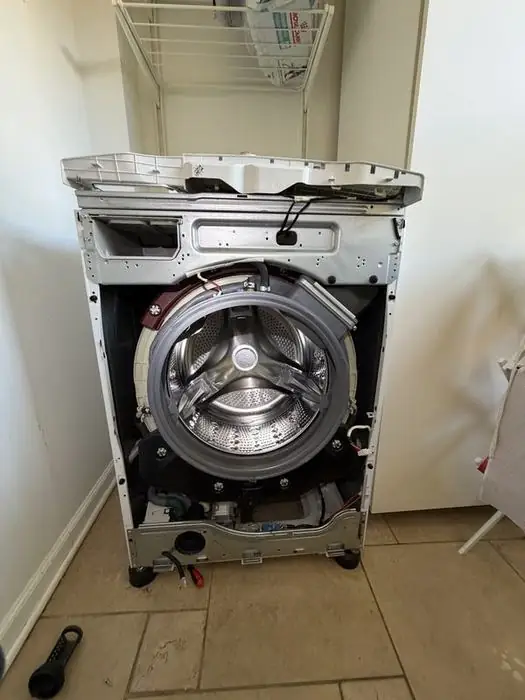
Washing Machine Not Spinning and Clothes Coming Out Soaked
A washer that fills and runs but leaves clothes heavy and wet is usually failing somewhere in the spin cycle, not the drain.
Lid switch or door latch. Front-load and top-load machines both refuse to spin if the machine does not sense the door or lid is closed and locked. A worn switch can read as open even when it is not.
Drive belt. On belt-driven machines, a worn, glazed or snapped belt spins the drum slowly or not at all, even though the motor runs fine.
Motor coupler. Some top-load washers use a plastic coupler between the motor and the transmission that is designed to fail before the transmission does. It is a cheap part with a recognizable symptom: the drum agitates but never spins.
Unbalanced or overloaded wash. Sometimes it is not a part failure at all. A single heavy item, like a comforter, can trip the balance sensor and stop the spin cycle before it starts.
We can usually tell which of these it is in one visit.
Here is what Northern Virginia homeowners have said about us on Google.
EXCELLENT

Based on 17 reviews

Posted on Google 

Kellee Johnson
Trustindex verifies that the original source of the review is Google. Service was on time. He gave me a heads up prior to his arrival. He was kind, professional and friendly. I will absolutely be passing his information on to others. Excellent service!
Owner's reply
Thank you for your feedback. Glad we were able to assist you with your appliance repair !
Owner's reply
Thank you for your feedback. Glad we were able to assist you with your appliance repair !
Posted on Google

Dawn Grega
Trustindex verifies that the original source of the review is Google. Matt was super responsive and diagnosed my washing machine over a short phone call. He ordered the parts right away and kept me updated until they arrived. He scheduled the repair for the next day, showed up on time, and did excellent work. I highly recommend My Appliance Repair!
Owner's reply
Thank you for your feedback ! We really appreciate it ! 😀
Owner's reply
Thank you for your feedback ! We really appreciate it ! 😀
Posted on Google

sabina nur
Trustindex verifies that the original source of the review is Google. They just fixed my oven. They were able to come during a holiday and on time! They were very professional and kind. Will absolutely use them again 💯
Owner's reply
Thank you for your feedback. We glad our team was able to help you !
Owner's reply
Thank you for your feedback. We glad our team was able to help you !
Posted on Google

Nikolas Marquez
Trustindex verifies that the original source of the review is Google. Great service and communication. I called around 12 pm and my washer was fixed by 5 pm. Matt was very helpful and their team will be my go to for any appliance service in the future.
Owner's reply
Thank you! We always try to help our customers in a timely manner.
Owner's reply
Thank you! We always try to help our customers in a timely manner.
Posted on Google

Katie Tanner
Trustindex verifies that the original source of the review is Google. Matt was here on time, diagnosed the issue with our freezer and came back the next day with the part. He fixed it in less than 30 minutes! I'm absolutely impressed with this company and their awesome service!
Owner's reply
Thank you for your feedback. We’re glad you were happy with our service !
Owner's reply
Thank you for your feedback. We’re glad you were happy with our service !
Posted on Google

Lynda Hill
Trustindex verifies that the original source of the review is Google. Matt was great - professional and thorough - and kept me informed about everything he was doing to make sure the washer was working properly. He went above and beyond to check out and adjust things on my dishwasher and microwave when I mentioned small issues. Just a wonderful experience and a very fair price too. I will definitely use him again for any future appliance repair needs!
Owner's reply
Thank you for your feedback. We truly appreciate your support and glad we could help. Thank you for choosing My appliance care.
Owner's reply
Thank you for your feedback. We truly appreciate your support and glad we could help. Thank you for choosing My appliance care.
Posted on Google

Petru Stratan
Trustindex verifies that the original source of the review is Google. Highly recommend, very professional!
Owner's reply
Thank you for your recommendation. It was pleasure helping you, and we looking forward to assisting you with the future appliance repairs.
Owner's reply
Thank you for your recommendation. It was pleasure helping you, and we looking forward to assisting you with the future appliance repairs.
Posted on Google

Roberta Russo
Trustindex verifies that the original source of the review is Google. Fast service, recommended
Owner's reply
Thank you for 5 star review. Looking forward to help you with your future appliances repairs !
Owner's reply
Thank you for 5 star review. Looking forward to help you with your future appliances repairs !
Posted on Google

Quality Pro Movers
Trustindex verifies that the original source of the review is Google. Excellent service from start to finish! The technician arrived on time, quickly diagnosed the problem, and repaired my appliance the same day. He was professional, knowledgeable, and took the time to explain everything clearly. The pricing was fair, and the repair was done right the first time. I highly recommend this company to anyone needing appliance repair and will definitely use them again in the future!
Owner's reply
We’re glad you were happy with our service and repair ! Looking forward to to helping you again.
Owner's reply
We’re glad you were happy with our service and repair ! Looking forward to to helping you again.
Posted on Google

Edu Eduard
Trustindex verifies that the original source of the review is Google. My dryer started giving off a burning smell, so I called this appliance repair company in Alexandria. They were able to schedule me quickly, and the technician arrived on time. Matt thoroughly inspected the dryer, found the problem right away, and fixed it the same visit. He explained everything clearly and made sure the dryer was operating safely before leaving. Excellent service, fair pricing, and very professional. I highly recommend them to anyone in Alexandria needing appliance repair.
Owner's reply
Thank you for taking the time to leave us review ! We’re appreciate your trust in our team and are here if you ever need assistance in the future !
Owner's reply
Thank you for taking the time to leave us review ! We’re appreciate your trust in our team and are here if you ever need assistance in the future !
Verified by Trustindex
Trustindex verified that these reviews were published on MY appliance care-Fairfax's Google Business Profile. Learn more
Get the Price Before Any Work Starts
Tell us what the appliance is doing and we will get a technician out, usually the same day or the next.
How the Visit Works
Three steps, no surprises in the middle.
Diagnose
Your technician listens to what the appliance is doing, then tests the parts that actually cause that symptom. No guessing, and no swapping parts to see what sticks.
Quote
You get the price for the repair before any work starts. If you would rather not go ahead, that is fine, and nothing happens without your say-so.
Repair
Most jobs finish in one visit, because the van is stocked for the failures we see week in and week out on common brands and models.
Washing Machine Types We Service
Every washer style handles water and motion differently, so the likely failure changes with the type. We work on the full range, from traditional agitator machines to newer high-efficiency and stackable units built for smaller spaces.
- Front load
- Top load with an agitator
- Top load, high-efficiency (no agitator)
- Stackable
- Compact and apartment-size
- Smart or app-connected models
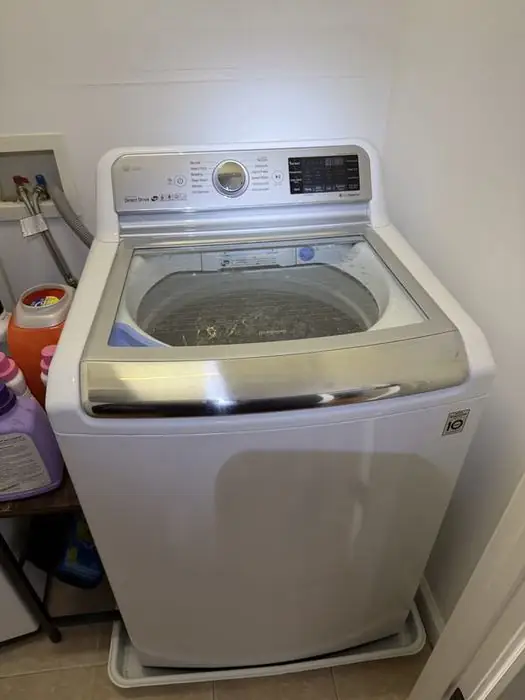
Brands We Service
We service all major brands and models, including Whirlpool. Our technicians train continuously as manufacturers change platforms, so a newer inverter motor or a proprietary control board is not a reason to send you elsewhere.
Common Questions
It starts with a diagnostic visit. The technician finds the actual fault, then gives you a firm price, and you decide before any work begins. As a rule of thumb, repair makes sense well under half the cost of replacing.
Most of the time, the same day or the next. We take appointments six days a week across Northern Virginia. Call (571) 357-5201, tell us what the appliance is doing, and we will find you the earliest slot we have.
Most leaks come from one of three places: a worn door boot seal on a front-load machine, a loose or cracked hose fitting at the back, or a detergent dispenser that is overflowing from too much soap. A technician traces the water rather than guessing.
Yes. The failure points differ between the two, but our technicians work on both, along with high-efficiency and stackable models.
Other Appliances We Repair
Washing machines are one part of what we do. We also repair refrigerators, dryers, dishwashers, and ovens and stoves, following the same process every time: diagnose, agree the price, then do the work.
Where We Work
We cover Northern Virginia, and we will tell you up front if you fall outside the range. Call (571) 357-5201 or request service online and we will get a technician scheduled.